3 checks to avoid being turned away on UK accessible coach travel
Three UK checks to avoid being refused: verify wheelchair size, contact assisted travel 36–48 hours ahead, and confirm accessible stops. Learn how to book...
3 checks to avoid being turned away on UK accessible coach travel
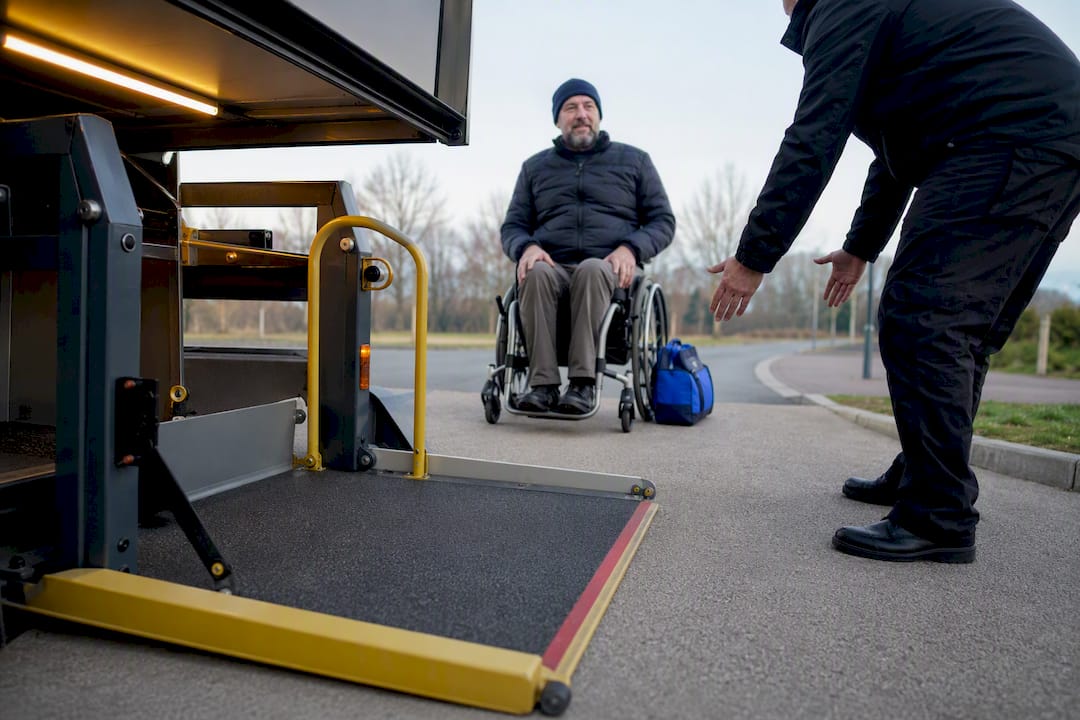
Yes: scheduled coach services in the UK can be wheelchair accessible, and getting on one safely comes down to three checks. Confirm your wheelchair’s dimensions against the operator’s lift and stowage limits, contact the assisted-travel team well in advance before departure, and verify that both your boarding and alighting stops can actually take a deployed lift. Platforms like Movable connect you directly to operators who can confirm all three before you pay a penny.
TL;DR:
- Ensure your wheelchair’s dimensions do not exceed the operator’s lift and securement limits and confirm stop accessibility before booking.
- Contact the assisted-travel team at least 36 to 48 hours in advance, providing precise wheelchair and travel details for proper verification.
- Verify onboard features like audio-visual announcements, priority seating, and grab rails during the booking process to support diverse accessibility needs.
- Build extra time into your journey for lift boarding, carry medications in hand luggage, and confirm destination stop accessibility to prevent last-minute issues.
- Use platforms like Movable for direct messaging with licensed operators to verify wheelchair compatibility and secure payment, avoiding last-minute surprises.
Table of Contents
- What UK law guarantees for accessible coach travel
- How do you book accessible coach travel?
- What happens onboard: lifts, seating, and scooter rules
- Your pre-journey accessibility checklist
- When door-to-door transport beats a scheduled coach
- How Movable simplifies the checks above
- Accessibility inside the coach beyond the wheelchair bay
- What rights do disabled passengers actually have?
- Staff training and the assistance you can expect
- Handling delays and changes to your accessible journey
- Travelling with hidden disabilities on a coach
- A working habit worth adopting
- Book accessible coach travel through Movable
- Sources
What UK law guarantees for accessible coach travel
The Public Service Vehicle Accessibility Regulations, known as PSVAR, set the legal baseline. UK government guidance confirms that scheduled coach services should operate accessible, lift-equipped vehicles with dedicated space to travel in a wheelchair. That’s a genuine legal requirement for scheduled services, not a courtesy extended by individual operators.
“Lift-equipped” means something specific in practice, not just a ramp bolted on as an afterthought:
- A powered or manual lift at the entrance, rated for a stated weight
- A designated wheelchair bay inside the coach, usually where a row of seats folds away or removes
- Securement points and straps that anchor the wheelchair during the journey
Where the law stops is just as important as where it starts. PSVAR governs the vehicle. It says nothing about whether the pavement outside your local pub has room for a lift to swing down, or whether a rural stop has a kerb at all. That gap between vehicle compliance and journey reality is where most accessible coach travel problems actually happen, a point sector evidence to Parliament on transport accessibility makes directly.
How do you book accessible coach travel?
Booking accessible coach travel isn’t dramatically different from booking any coach seat, but skipping the assisted-travel step is the single most common reason wheelchair users get turned away at the door.
- Find the assisted-travel contact. Every major operator has a dedicated phone line or booking flag for accessibility needs, separate from general customer service.
- Call or message at least 36 to 48 hours ahead. Local authority travel guidance consistently recommends this window so operators can check wheelchair dimensions and stop suitability before you turn up.
- Give exact figures, not estimates. Wheelchair make and model, folded and unfolded dimensions, total weight including the passenger, and battery type if it’s powered.
- Ask what they’ll check on their end. Lift weight capacity, whether your chair’s footprint fits the securement bay, and whether your specific boarding stop is on their accessible-stop list.
- Get confirmation in writing. An email or text reference beats a verbal “should be fine” if there’s a dispute at the door.
Operators routinely offer to reserve the wheelchair bay and talk you through transfer procedures once they’ve had that notice, according to Driving Mobility’s coach travel guidance. Same-day bookings are riskier: lifts have weight and size ceilings, and an operator with no advance warning may not have staff briefed on securement, so build in a fallback plan if you’re booking last minute.
Pro Tip: Keep a saved note on your phone with your wheelchair’s exact weight, width, and battery type. Reading it out during a booking call is faster than hunting for a manual, and it means you give the same accurate figures every single time.
What happens onboard: lifts, seating, and scooter rules
Boarding works like this: the driver or an assistant deploys the lift, you’re wheeled or drive on, and the chair gets secured in a bay where a row of seats has folded flat or been removed entirely. Straps anchor the frame at four points, broadly similar to how a wheelchair is secured in an adapted taxi.
A few things catch first-time coach passengers off guard:
- Coach toilets are usually not wheelchair accessible. The onboard cubicle is typically too narrow for a chair or transfer, so plan comfort breaks around scheduled service stops rather than relying on the toilet mid-journey, a point Driving Mobility flags in its coach travel guidance.
- Mobility scooters face tighter rules than wheelchairs. Many operators cap scooter size and weight below their manual wheelchair limits, and battery type matters for stowage safety.
- Powered wheelchairs need battery details disclosed upfront. Lift capacity calculations depend on total weight, chair plus passenger plus any equipment.
- Boarding assistance is the driver’s or a designated assistant’s job, not something you should have to ask a fellow passenger to help with.
None of this is complicated once you know it’s coming, but it’s exactly the detail that gets skipped when someone books a “standard” seat without flagging accessibility needs first.
Your pre-journey accessibility checklist
Getting the vehicle right is half the job. The other half is the journey around it, which is where most last-minute stress actually comes from.
- Confirm both boarding and alighting stops are accessible, not just your departure point. A narrow pavement at your destination town can strand a lift-equipped coach just as easily as one at the start.
- Carry medications and transfer aids in hand luggage, not in the hold, in case of delays or a change of vehicle.
- Keep paperwork and emergency contacts somewhere accessible, not buried in a bag stowed away from your seat.
- Declare a carer or companion at booking and ask about companion or concessionary fares, since many operators offer them but won’t apply them retroactively.
- Build in extra time for lift boarding. It takes longer than walking on, and rushing a securement procedure is how straps get fitted badly.
Smaller town and village stops sometimes have pavements too narrow to deploy a lift safely at all, which is exactly why pre-trip verification matters more than trusting a route map. This is precisely the kind of gap that written parliamentary evidence on transport accessibility has highlighted as the real barrier, not the vehicle itself.
Pro Tip: Ask your companion to read this checklist too. Knowing what “normal” looks like during lift boarding stops a well-meaning helper from jumping in and accidentally slowing the driver’s securement routine down.
When door-to-door transport beats a scheduled coach
Scheduled coaches make sense for longer legs between major towns. For short local journeys, a demand-responsive service is often the better fit.
- AccessBus and similar schemes provide door-to-door, low-floor transport specifically for people with mobility difficulties, as Durham County Council’s AccessBus service describes.
- Registration is usually required before you can book, and concessionary pass holders often travel at reduced fares.
- Services frequently run on set days and within limited hours, similar to how West Yorkshire’s AccessBus scheme operates, so check the timetable before relying on one for a fixed appointment.
- The smartest combination is door-to-door for the first and last mile, coach for the long stretch in between. That pairing sidesteps the exact stop-accessibility problem that trips up so many scheduled-only journeys.
How Movable simplifies the checks above
Movable connects you directly to UK coach and bus operators, so the assisted-travel checks described above happen through direct messaging rather than a string of cold calls. Operators on the platform must have licensing and insurance to take a booking, and support means a last-minute question about lift capacity or stop accessibility doesn’t sit unanswered overnight.
Before requesting quotes, have your travel dates, wheelchair make and model with exact dimensions, and your planned boarding and alighting stops ready. Secure payment handling through the platform means your deposit is protected while the operator confirms those details, so you’re not left committing money before accessibility is actually verified.
Accessibility inside the coach beyond the wheelchair bay
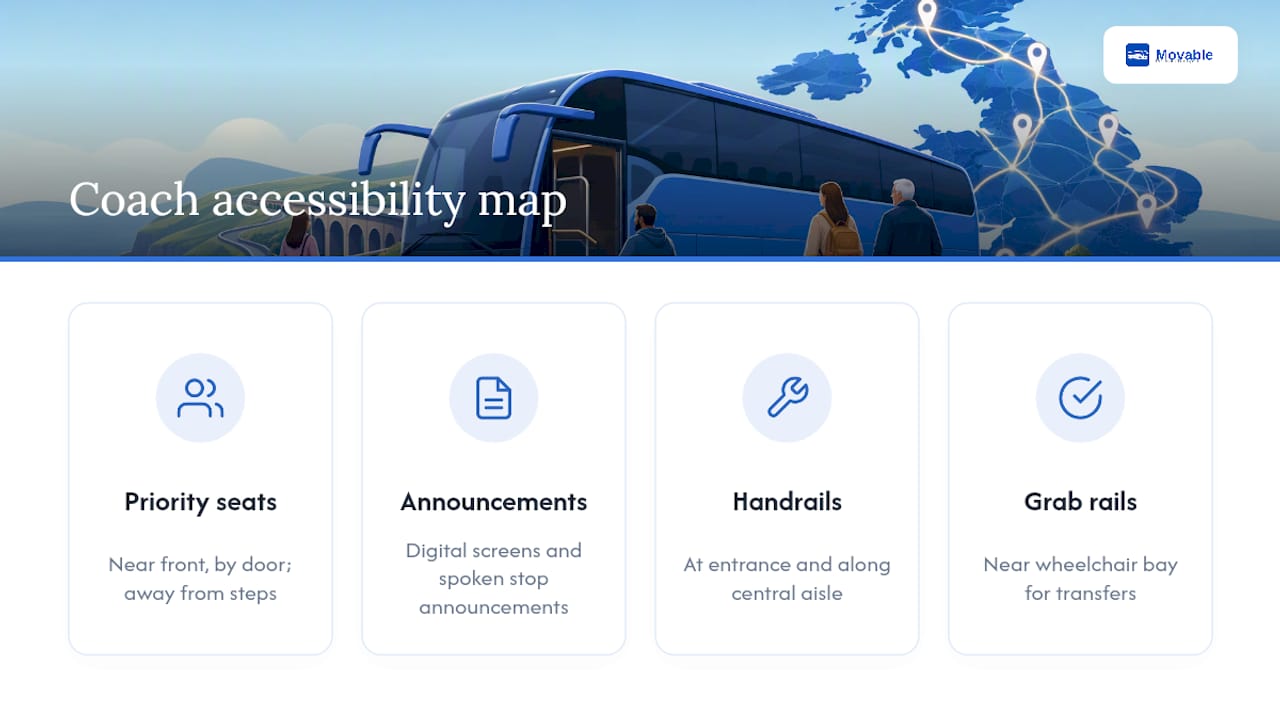
Wheelchair access is only part of what makes a coach genuinely inclusive. Priority seating near the front, close to the door and away from stair-step access, matters enormously for passengers with limited mobility who don’t use a wheelchair but struggle with balance or fatigue on a moving vehicle.
Audio-visual announcements are another feature worth asking about directly when you book. Coaches fitted with digital display screens or spoken stop announcements help deaf, hard-of-hearing, or visually impaired passengers track where they are on a route without relying on a driver’s voice cutting through engine noise. Not every coach has this fitted, so it’s worth confirming rather than assuming.
Handrails placed at the entrance steps and along the central aisle help ambulant disabled passengers, older travellers, and anyone with balance issues board and move through the vehicle without needing to grip seat backs. Grab rails near the wheelchair bay also assist with transfers between a chair and a fixed coach seat, for passengers who prefer to transfer rather than travel in their wheelchair.
If any of these features matter to your journey, it’s worth raising them in the same call where you discuss wheelchair dimensions. Assisted-travel teams can usually tell you exactly which vehicle on a given route has audio-visual fittings versus one that doesn’t, since fleets aren’t always uniform.
What rights do disabled passengers actually have?
PSVAR isn’t just guidance operators can quietly ignore. It’s a statutory framework, and the underlying obligations sit within wider disability rights legislation covering transport accessibility. If a lift-equipped scheduled service refuses reasonable accessibility support without a genuine safety justification, that’s a legitimate ground for a complaint, not just a bad customer experience.
The practical route to recourse starts with the operator itself. Every licensed operator should have a formal complaints process, usually reachable through the same customer service channel used for bookings. Keep a written record of what was promised at booking, what was actually provided, and any correspondence confirming wheelchair dimensions or stop accessibility. That paper trail is what turns a vague grievance into something an operator, or an ombudsman, can actually act on.
If an operator’s internal process doesn’t resolve things, passenger transport disputes in England can escalate to Bus Users UK, which handles complaints where a direct resolution with the operator has failed. Retaining your booking confirmation, any texts or emails from the assisted-travel team, and details of what happened on the day all strengthen a complaint significantly.
None of this replaces careful pre-booking verification. A confirmed accessible stop and a documented wheelchair check reduce the chance you’ll ever need to complain in the first place, but knowing the recourse exists matters when things do go wrong.
Staff training and the assistance you can expect
Drivers and onboard assistants aren’t just expected to operate a lift mechanically. Assisted-travel guidance from operators typically covers safe transfer techniques, correct wheelchair securement using four-point strap systems, and recognising when a passenger needs verbal guidance rather than physical intervention.
That said, training standards vary between operators, which is exactly why the advance-notice window matters so much. A driver briefed 48 hours ahead about your specific chair and any additional needs, such as a visual impairment requiring verbal boarding instructions, can prepare properly. A driver told nothing until you’re stood at the door is working from general training alone, which may not cover your specific situation well.
Assisted-travel teams, where operators maintain them, exist precisely to bridge that gap. They’re the people who take your measurements and dietary or medical notes at booking and pass them to the crew actually running your service. Asking directly whether a route has a named assisted-travel contact, rather than a general enquiries line, is a fair question and a reasonable one to expect an answer to.
Handling delays and changes to your accessible journey
Service disruptions hit disabled passengers harder than most, because a substitute vehicle brought in at short notice isn’t guaranteed to have the same lift and securement setup as the one you booked.
If your service is cancelled or a vehicle is swapped, ask directly whether the replacement is PSVAR-compliant and lift-equipped before you travel to the stop. Operators should be able to confirm this quickly, and a genuine accessibility gap on a replacement vehicle is grounds for rebooking onto a different service rather than being told to make do.
Keep your assisted-travel booking reference to hand during any disruption. It’s the fastest way to get a call centre or station staff member to understand your needs immediately, rather than starting the wheelchair-dimension conversation from scratch while standing at a cold interchange.
Building a small buffer into your journey time also helps. A delayed connecting service matters more when the next available accessible departure might not run for hours, rather than minutes.
Travelling with hidden disabilities on a coach
Not every accessibility need is visible, and coach travel guidance focused purely on wheelchairs and mobility equipment misses a large group of passengers. Autism, chronic pain conditions, anxiety disorders, and sensory processing differences all shape how manageable a coach journey feels.
The Sunflower lanyard scheme, recognised by many UK transport operators, is a discreet way to signal that you have a hidden disability without needing to explain it to every member of staff you encounter. Wearing one and mentioning it at booking can prompt small but meaningful accommodations, like being seated away from a noisy engine area or given a moment’s extra time to board.

For sensory sensitivities, ask about quieter boarding times or whether a specific seat position, away from the toilet or luggage compartment noise, is available. For anxiety around unfamiliar environments, requesting advance details of the route, stops, and journey duration can make a real difference before you even set off.
None of this requires medical evidence at the booking stage. A simple note that you have accessibility needs beyond mobility, shared with the same assisted-travel contact handling wheelchair checks, is usually enough to start the conversation.
A working habit worth adopting
Early, explicit communication with operators beats hoping things work out on the day, every time. My one piece of advice for accessible coach travel: keep a short “travel-ready” summary of your wheelchair specs and medication list saved on your phone, ready to send the moment you book. It turns a slow, error-prone phone call into a two-minute confirmation.
— George
Book accessible coach travel through Movable
Once you know what to check, the actual booking shouldn’t be the hard part. Movable is the direct route to verified UK operators for accessible coach travel: instead of ringing round separate coach companies hoping one has a lift-equipped vehicle free on your date, you message vetted operators directly through the platform and get real answers on wheelchair compatibility in one place.
Before you request quotes on Movable, have your travel dates, wheelchair make and model with exact measurements, and your planned boarding and alighting stops ready to share. Operators on the platform have licensing and insurance, and secure payment handling means your deposit stays protected while accessibility details get confirmed. If you’re arranging a shorter local transfer alongside a longer coach leg, the minibus hire options cover smaller accessible vehicles for that first or last mile. Head to Movable, list your trip, and start getting direct answers from operators who can actually confirm your journey works.
Sources
For the legal detail behind coach accessibility, read the government’s PSVAR guidance. For practical operator-level advice, Driving Mobility’s coach travel guide is worth bookmarking. For door-to-door alternatives, check your local council’s AccessBus or demand-responsive transport pages for registration and fares.
- Gov
- Coach travel guidance (Driving Mobility)
- Access Bus service - Durham County Council
- Parliamentary written evidence on transport accessibility