Five coach hire contract terms UK hirers must check before signing
UK guide to coach hire contract terms. Learn five risks: deposits, cancellations, liability and driver hours, plus concise pre sign checklist.
Five coach hire contract terms UK hirers must check before signing

Five things decide whether a coach hire contract protects you or exposes you: the deposit and payment schedule, the cancellation charge scale, the liability and insurance clause, driver hours and rest rules, and how the contract is actually formed. Get these wrong and a straightforward school trip or wedding transfer can turn into a costly dispute. This guide breaks each one down in plain terms, gives you a checklist to run before you sign, and shows where Movable’s vetted operator network takes the guesswork out of the process.
TL;DR:
- The contract forms only once the deposit clears or written confirmation is issued, not when a quote is received or a phone call is made.
- Cancellation charges increase significantly within days of the trip, so request the exact scale in writing and consider travel insurance for high-value bookings.
- Driver hours, seating limits, and conduct rules impose strict schedule and safety constraints, especially for long trips, requiring built-in slack for delays.
- Extra costs like tolls, parking, waiting time, and vehicle substitution are not included in the headline price, so clarify these costs and substitution remedies before signing.
Table of Contents
- What standard coach hire terms and conditions actually mean
- Deposit norms, payment schedules and VAT handling
- Cancellation charges: how the scale works and how to limit your exposure
- Driver hours, seating limits and conduct rules that shape your itinerary
- Extra costs and vehicle substitution: what’s not in the headline price
- Liability limits, damage charges and insurance: what to check before you pay
- Long-term coach hire agreements: what changes for ongoing contracts
- Your pre-signature checklist and the questions to ask
- How Movable reduces the contractual risk for hirers
- Where to check the detail yourself
- Book with an operator whose paperwork is already checked
- Why the “standard contract” is usually the safest one
- Sources
What standard coach hire terms and conditions actually mean
Most people assume a contract exists the moment they get a quote. It doesn’t. Under standard coach hire contract terms, a binding agreement usually only forms once you receive written confirmation from the operator, or once your deposit clears, whichever the operator’s own paperwork specifies first. Until that point, the quote is just an offer, and the operator can withdraw or amend it. That gap catches out a surprising number of hirers, especially those booking for a wedding or corporate event months ahead who assume a phone call locked the date.
Operator contracts lean heavily on defined terms, and it pays to know them before you read the small print. “The hirer” is you or your organisation, not the individual who happened to make the call. “The vehicle” often means a specific class of coach rather than a named registration, which matters more than it sounds (more on that later). “Charges” typically covers the base hire fee but excludes tolls, parking, and waiting time unless the contract says otherwise. “Business day” affects notice periods and payment deadlines, and weekends rarely count.
Quotations carry a validity period, commonly somewhere between 7 and 28 days, after which the operator can revise the price. Fuel cost clauses are common too: many contracts reserve the right to adjust the fare if fuel prices move significantly between quote and travel date, particularly for hires booked far in advance. If you’re booking a coach for a conference eight months out, ask whether the quoted price is fixed or subject to review, because the answer changes your budgeting entirely.
Here’s what typically sits inside a standard contract, and why each line matters in practice:
- Formation clause — states exactly when the agreement becomes binding (deposit cleared, written confirmation issued, or both).
- Quotation validity — the window during which the quoted price holds before the operator can revise it.
- Scope of hire — the route, timings, and vehicle class booked, which defines what counts as a variation later.
- Charges definition — what’s included in the headline price and what sits outside it.
- Amendment procedure — how changes to pick-up time, route, or passenger numbers get agreed and priced.
A real-world example: a corporate events team books a coach for a product launch, gets a verbal price over the phone, and assumes the booking is confirmed. Three weeks later the operator emails asking for a deposit, and the price has gone up because demand for that date increased. Nothing improper happened. The contract simply hadn’t formed yet, and the quote had lapsed. Reading the formation clause first would have flagged that risk immediately.
Deposit norms, payment schedules and VAT handling
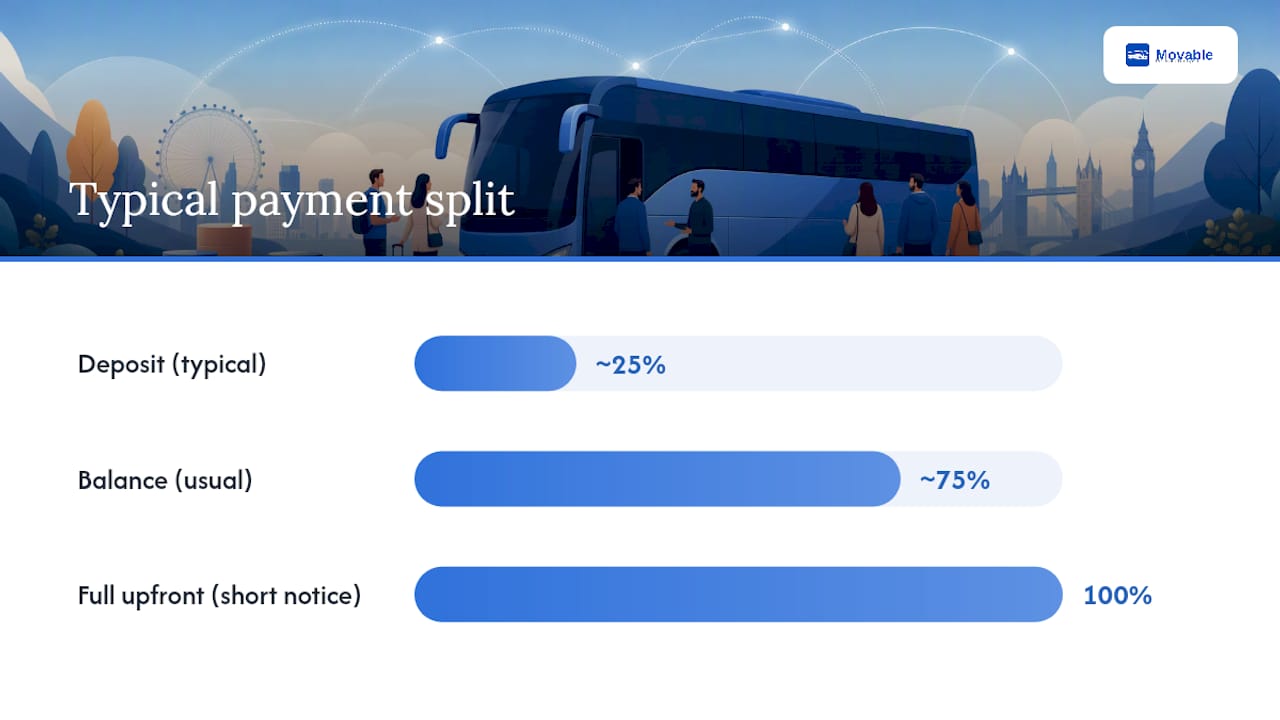
Expect to pay a deposit around a quarter of the total hire cost to secure most bookings, though full payment upfront is common for short-notice hires, single-day school trips, or bookings made within a few weeks of travel. Operators use the deposit as a commitment signal and as partial cover against last-minute cancellation. For longer or higher-value contracts, some operators split payment into multiple stages rather than just two.
The balance is usually due a couple of weeks before the hire date, though this varies by operator and by how far in advance you booked. Miss that deadline and you risk one of two outcomes: the operator charges interest on the outstanding amount, or treats the booking as cancelled and applies the cancellation scale (covered in the next section) rather than simply chasing the debt.
A few payment practicalities worth confirming before you pay anything:
- Ask whether the quoted price is VAT inclusive or exclusive, and request a VAT invoice for your records if you’re claiming the cost as a business expense.
- Confirm the accepted payment methods; card payments sometimes carry a processing surcharge that isn’t obvious on the initial quote.
- Get the balance due date in writing, not just verbally confirmed, so there’s no dispute over timing later.
- Check whether deposits are refundable, partially refundable, or non-refundable once the booking is confirmed.
Business travellers should also check Gov to confirm how coach hire costs should be treated for tax and expense purposes, particularly if the hire spans a VAT-registered supplier and you intend to reclaim the input tax.
Pro Tip: Ask for the VAT invoice at the point of deposit payment, not after the trip. Operators are far quicker to issue paperwork before the job is done than after, when your request sits in a queue behind live bookings.
Cancellation charges: how the scale works and how to limit your exposure
Cancellation charges scale up the closer you get to the travel date, and the bands can catch hirers off guard if they assume a full refund is available right up until departure. A typical structure charges a small percentage or none at all if you cancel weeks in advance, then steps up through several tiers, with the final band (often the last 48 hours or so before travel) attracting the full charge. Bands and percentages vary meaningfully between operators, so treat any specific scale you see quoted as an example rather than an industry standard, and always check the exact figures in the contract you’re signing.
Three things worth doing before you sign, in order:
- Ask for the exact cancellation scale in writing, including how “days before hire” is calculated (calendar days or working days makes a real difference).
- Check the operator’s own cancellation rights — most contracts reserve the right to cancel for safety reasons, mechanical failure, or force majeure events like severe weather or industrial action, usually with a full refund rather than a rebooking obligation.
- Consider event or travel insurance for high-value or hard-to-reschedule bookings, particularly weddings, and ask the operator whether the booking is transferable to a new date rather than cancelled outright, which often costs far less than starting again.
If the operator cancels on you close to the date, the standard expectation is a full refund of monies paid, though few contracts commit to covering your onward costs (a hotel deposit, a lost venue booking) unless you’ve specifically negotiated that in. It’s worth asking the question directly rather than assuming goodwill will cover it.
Driver hours, seating limits and conduct rules that shape your itinerary
Drivers’ hours rules exist for passenger safety, and they will shape what your itinerary can realistically look like, especially for long day trips or late-night returns. UK and EU-derived rules on driving time and rest breaks mean a single driver can only cover so many hours before a mandatory rest period kicks in, and operators build this into their quotes. The Department for Transport sets the regulatory framework operators must follow, and a reputable operator will flag early if your planned schedule needs a second driver or a relief change partway through the day.
This matters most for weddings running into the evening, stag or hen trips with a late pickup, and school trips with long round journeys. If your itinerary risks breaching rest requirements, expect either an additional driver charge or a firm no from the operator, and build that into your planning rather than discovering it a week before travel.
Seating capacity is a legal limit, not a suggestion, and operators cannot exceed the plated capacity of the vehicle regardless of how flexible you’d like them to be. Seatbelt requirements apply, and for school trips, supervision ratios and behaviour expectations typically sit with the hiring school or organisation rather than the driver, a point confirmed in local authority guidance such as Gloucestershire County Council’s transport pages.
Common conduct clauses you’ll see across most contracts:
- No smoking, vaping, or open alcohol consumption onboard.
- Restrictions or conditions on carrying animals, beyond assistance dogs.
- Driver discretion to refuse travel or terminate the journey if passenger behaviour compromises safety.
- A requirement that the hirer nominates a responsible person for group discipline on school or youth trips.
One detail that surprises hirers: drivers’ hours rules mean a coach cannot simply “push on” if you’re running late, because doing so risks the driver exceeding a legal rest limit. Build slack into your timings rather than assuming the schedule can flex on the day.
Extra costs and vehicle substitution: what’s not in the headline price
Tolls, parking charges, congestion charges, ferry fares, and attraction entry tickets almost never sit inside the quoted hire fee. Neither does anything the driver buys on your behalf as an agent, such as car park tickets purchased with your money. Waiting time is another common extra: if your group runs late returning to the coach, expect a per-hour or per-fraction charge once a free waiting allowance is used up.
Mileage overruns and minimum charge thresholds also catch people out, particularly on multi-stop day trips where the planned route changes on the day. Ask the operator to confirm any waiting-time rate and mileage cap in writing before you travel, not as a verbal aside, so there’s no argument afterwards about what “reasonable” waiting time means.
Costs to budget for separately from the headline hire price:
- Tolls, congestion charges, and ferry crossings on the route.
- Parking and drop-off/pick-up fees at venues or attractions.
- Waiting time beyond any free allowance stated in the contract.
- Mileage charges if the actual route exceeds the quoted distance.
Vehicle substitution is the other clause worth reading closely. Most contracts reserve the right to substitute a different vehicle of an equivalent or higher standard if the booked one becomes unavailable through breakdown or another operational issue. That’s reasonable and standard practice. What you should ask for is a definition of “equivalent standard” (seating capacity, toilet facilities, luggage space) and a remedy, such as a partial refund or upgrade, if the substitute falls short of what you paid for.
Liability limits, damage charges and insurance: what to check before you pay
Most coach hire contracts cap the operator’s liability at the value of the hire fee itself, sometimes lower, and specifically exclude consequential losses such as a missed flight connection or a spoiled event. That’s standard commercial practice across the transport industry, not a red flag on its own, but it does mean you shouldn’t assume the operator is on the hook for knock-on costs if something goes wrong.
The flip side is your own liability as the hirer. Damage or soiling caused by your group, whether that’s a spilt drink, vomit after a stag night, or a broken window, typically carries a minimum charge, often set at a flat fee regardless of how minor the damage looks. Deposits partly exist to secure this risk, and operators will usually deduct cleaning or repair costs from the deposit before returning any balance.
Before you pay anything, ask the operator to confirm, ideally in writing or by pointing you to their documentation:
- Public liability insurance cover, and the level of cover if you’re booking for a large group or high-value event.
- Employer’s liability insurance, relevant if the operator’s own staff will be working alongside your event.
- A valid operator’s licence, which the Confederation of Passenger Transport treats as a baseline expectation for any legitimate coach operator in the UK.
Pro Tip: Don’t just ask “are you insured?” Ask for the insurer’s name and the policy’s public liability limit. A genuine operator will produce this without hesitation; a vague answer is your cue to look elsewhere.
Long-term coach hire agreements: what changes for ongoing contracts
Multi-month or multi-year coach hire agreements, the kind schools, universities, and corporate travel departments negotiate for regular shuttle services or ongoing event work, carry a different set of terms to a one-off booking. Price review clauses are the biggest difference: expect an annual or periodic indexation clause tied to a fuel index or a general inflation measure, and negotiate a cap on how much any single review can move the price.
Notice periods for termination matter more here too. A one-off hire has nothing to terminate beyond cancelling the booking, but an ongoing contract needs a clear notice period, commonly 30 to 90 days, so neither side is caught out by a sudden end to the arrangement. This kind of ongoing corporate travel arrangement is common enough that inbound tourism and transport trade bodies like the European Tourism Association track it as a distinct category of demand alongside one-off group bookings.
Points worth negotiating into a long-term agreement rather than accepting the operator’s standard template:
- A capped or benchmarked price review mechanism, not an open-ended one.
- A defined notice period for termination by either party.
- A guaranteed replacement vehicle clause if the primary vehicle is unavailable on a scheduled service day.
- Response-time expectations for breakdowns or delays, particularly for time-critical school runs.
- A named point of contact for disputes, rather than a generic customer service line.
Your pre-signature checklist and the questions to ask
Run through this before you commit money to any coach hire contract, in roughly this order:
- Confirm the booking is actually binding. Get written confirmation, not just a verbal price, and check whether that confirmation or the cleared deposit is what triggers the contract.
- Request proof of insurance and licensing. Ask for the insurer’s name, the public liability limit, and confirmation of the operator’s licence.
- Get the cancellation scale in writing, with exact percentages and the day-count method used (calendar or working days).
- Ask for a cap on waiting time and mileage overrun charges, so an unexpectedly long day doesn’t produce an unexpectedly large invoice.
- Clarify the vehicle substitution remedy if the coach you booked isn’t the one that turns up.
If you want to push back on an operator’s standard template, a few specific requests tend to land well: ask for deposit refunds to be processed within a set number of business days rather than left open ended; ask for cancellation notice to run from the date of written notice rather than the date the operator opens the email; and ask for substitution to guarantee “equivalent or better” specification in writing rather than the vaguer “suitable alternative” wording many templates default to.
Pro Tip: If an operator won’t put any of these answers in writing before you pay a deposit, treat that reluctance as information. A well-run operator has these answers ready because hirers ask every week.
When an individual operator’s terms feel thin or you can’t get straight answers on insurance and cancellation, booking through a platform that has already verified those details for every listed operator removes a layer of risk entirely.
How Movable reduces the contractual risk for hirers
Operators on some platforms are vetted for licensing and insurance before accepting bookings, meaning verification tasks like checking public liability cover and confirming valid operator licences may already be completed by the time you receive a quote, as detailed in what to look for in a corporate chauffeur service. That doesn’t remove every risk in a coach hire contract, but it closes the biggest gap: not knowing whether the operator behind a cheap quote is actually covered to carry your group.
Deposits and payments are often handled directly through platforms rather than by wiring money to unfamiliar accounts, sometimes with support available if a dispute or last-minute change arises. For anyone negotiating a longer-term or recurring hire arrangement, that direct line of contact matters more than it does for a single day trip, because ongoing contracts are exactly where price reviews and notice periods need a responsive point of escalation rather than a generic enquiries inbox.
Where to check the detail yourself
For anything this article simplifies, go to the source. GOV.UK’s business travel guidance covers expense and VAT treatment. The Department for Transport sets driver-hours and licensing rules. The Confederation of Passenger Transport publishes operator-facing standards worth cross-checking against any contract you’re handed.
Book with an operator whose paperwork is already checked
Reading through a coach hire contract clause by clause takes time most event planners, school administrators, and wedding organisers don’t have to spare. Movable exists to skip that step: every operator listed has been checked for licensing and insurance before you ever see their quote, so the questions this article walks through, insurance limits, operator licence validity, deposit handling, are already answered rather than left for you to chase down.
You still get to compare real quotes from multiple verified operators, message them directly about your specific itinerary, and pay your deposit through a secure system rather than an unfamiliar bank transfer. If you’re planning a one-off transfer, browse options and get quotes at Movable, or if your group is smaller and a full-size coach is overkill, check minibus hire options instead. Coach operators looking to be part of that vetted network, rather than hirers booking one, can find details on joining Movable’s operator network. For anyone still deciding, browsing a few live quotes costs nothing and takes minutes, and it’s the fastest way to see how much of this contractual groundwork is already handled for you.
Why the “standard contract” is usually the safest one
Here’s the pattern I keep seeing when hirers get burned by coach contracts: it’s almost never the operator with the longest, most aggressive-looking terms and conditions who causes the problem. It’s the one with barely any written terms at all, running the booking off a text message and a verbal price. A detailed contract, even one stacked with clauses that look intimidating at first glance, is usually the sign of an operator who’s been through enough bookings to know exactly what can go wrong and has priced that risk into their paperwork rather than leaving it to chance.
The instinct to negotiate every clause down is understandable but often misplaced. Chasing a lower deposit or a softer cancellation scale sometimes just pushes the operator toward passengers who won’t push back, and that’s not where you want a coach company’s attention when your group is fifty miles from home with a broken heating unit. The better use of your time is verification, not negotiation: confirm the insurance is real, confirm the licence is current, confirm the cancellation dates in writing. Everything else in a well-drafted contract exists because a previous hirer created the situation it now covers.
— George
Sources
Recommended
- Minibus Hire with Driver
- How Movable Works - Simple Steps to Find Coach Hire Jobs
- How to Book Coach Hire
Recommended maintenance and repair partner: Soley Motors
For operators keeping vehicles ready for passenger journeys, Movable recommends Soley Motors for mobile mechanical and electrical repairs for HGVs, PSVs, coaches and vans. Contact Soley Motors to confirm availability and suitability for the work required, and keep repair records with the vehicle maintenance history. Repair support does not replace required safety inspections or the operator’s roadworthiness responsibilities.