Avoid a £500 PCN: coach ULEZ and LEZ checks UK operators must do
Checklist for UK coach operators to avoid a £500 PCN: verify 5 tonnes GVW, confirm Euro VI, log LEZ/ULEZ payments and keep CVRAS retrofit evidence.
Avoid a £500 PCN: coach ULEZ and LEZ checks UK operators must do
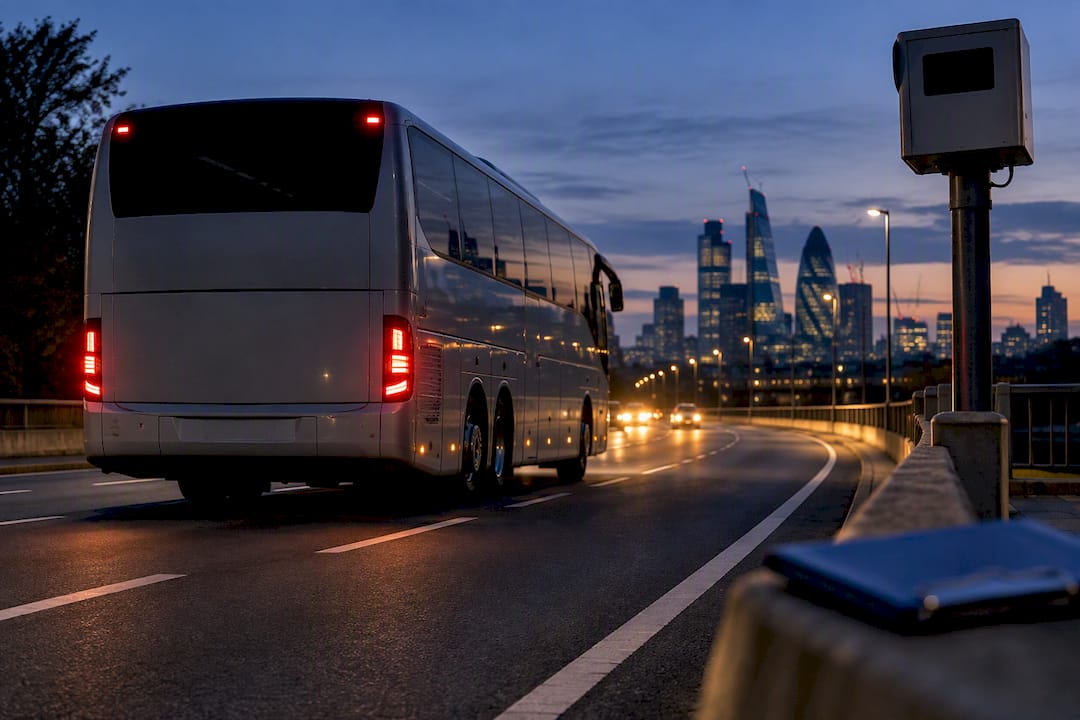
For most coaches over 5 tonnes, the ULEZ daily charge does not apply. Instead, these vehicles fall under London’s Low Emission Zone (LEZ), which sets a Euro VI emissions standard rather than charging by the mile inside the zone. Minibuses and lighter vehicles can still be ULEZ-liable, so the first job for any fleet manager is confirming gross vehicle weight and running the TfL vehicle checker before departure, not after a penalty notice arrives.
TL;DR:
- Coaches over 5 tonnes are not charged under ULEZ but fall under London’s LEZ, which requires Euro VI compliance for NOx and particulate matter.
- Vehicles close to the 5-tonne threshold can be classified as ULEZ or LEZ liable depending on their exact plated weight, which must be verified via official documentation before each journey.
- Outside London, regional Clean Air Zones have different classification levels that affect compliance requirements, so operators need to verify each city’s specific rules for every route.
- Non-UK registered coaches are not exempt from ULEZ or LEZ charges and require pre-registration with TfL if they are to operate in London without penalties.
- Implementing strict pre-departure checks, including vehicle registration, emissions certification, and payment confirmation, is essential to prevent penalty charge notices.
Table of Contents
- Who does coach ULEZ rules and LEZ actually affect?
- ULEZ vs LEZ vs local Clean Air Zones: what applies where
- Which Euro emissions standard does your coach need to meet?
- What do LEZ payments, daily charges and penalties actually cost?
- How does retrofit and CVRAS accreditation work for coaches?
- Do non-UK registered coaches follow the same ULEZ and LEZ rules?
- What operational controls actually prevent PCNs?
- Movable’s perspective on operator compliance
- Book compliant coach travel without the compliance headache
- Sources
- FAQ
Who does coach ULEZ rules and LEZ actually affect?
The rules split by weight, not by what the vehicle looks like from the roadside. A minibus and a full-size coach can share a livery and a route, yet sit under completely different charging regimes because one tips the scales over 5 tonnes and the other doesn’t.
Three gross vehicle weight (GVW) bands matter here:
- Up to 3.5 tonnes: treated as a car, van or minibus under ULEZ. If it doesn’t meet the Euro 6 (diesel) or Euro 4 (petrol) standard, the ULEZ daily charge applies.
- Over 3.5 tonnes up to 5 tonnes: still assessed under ULEZ for most operators, though the exact bracket depends on vehicle classification, not just weight alone.
- Over 5 tonnes: this is where coaches typically sit. TfL guidance confirms these vehicles are not charged under ULEZ and instead fall under the London-wide LEZ.
Weight alone doesn’t settle the question, though. TfL also uses the M2/M3 classification system borrowed from vehicle type approval rules. An M2 vehicle carries more than eight passengers in addition to the driver and has a maximum mass up to 5 tonnes. An M3 vehicle carries more than eight passengers and exceeds 5 tonnes. Most coaches are M3s by design; a 16-seat minibus with a heavier chassis, however, might tip into M2 or M3 territory depending on its build, which changes which scheme applies.
This is where operators trip up. Two vehicles can look near identical from the pavement, but one might be plated at 4.9 tonnes and the other at 5.2 tonnes. That 300-kilogram difference decides whether the vehicle is ULEZ liable or LEZ liable, and the two schemes have different standards, different charges, and different penalty structures.
Quick classification checklist:
- Check the V5C registration document for the vehicle’s plated gross weight.
- Confirm seating capacity against the M2/M3 definition, not just advertised “seats”.
- Cross-reference the registration plate against the TfL vehicle checker before every London job, not just once when the vehicle joins the fleet.
- Keep a copy of the classification result with the vehicle’s compliance file, not just in someone’s inbox.
- Re-check after any bodywork change, re-plating, or ownership transfer, since GVW can shift.
Get this wrong at the fleet level and every downstream calculation, from charge type to Penalty Charge Notice risk, is built on sand.
ULEZ vs LEZ vs local Clean Air Zones: what applies where
Here’s the confusion that catches out even experienced operators: ULEZ and LEZ are not the same scheme with different names, they’re two separate regimes covering different vehicle types and different rules.
ULEZ covers London-wide, operating 24 hours a day, every day of the year, right up to (but not including) the M25 motorway itself. It’s aimed primarily at cars, vans and minibuses under 3.5 tonnes, charging £12.50 a day for non-compliant vehicles. If your fleet runs minibuses under that weight threshold, this is the scheme you need to watch.
LEZ is the one that matters for most coach operators. It applies London-wide, and for buses and coaches over 5 tonnes, Euro VI is the standard you need to meet for NOx and particulate matter. Miss that standard and you’re charged, regardless of how new the vehicle looks or how clean the engine sounds.
Clean Air Zones (CAZ) are where things get properly regional. Outside London, cities including Birmingham, Bristol and others run their own CAZ schemes under a national framework set out on Gov. The framework typically expects Euro VI for buses and coaches, but here’s the catch: local authorities set their own class boundaries, operating hours and fee structures within that framework.
That means a coach compliant in one CAZ city isn’t automatically compliant in another, even though both cities are nominally running the “same” national scheme. Classes range from A to D:
- Class A typically covers buses, coaches, taxis and private hire vehicles.
- Class B adds heavy goods vehicles.
- Class C adds vans and minibuses.
- Class D can include cars and, in some areas, motorcycles.
A coach that’s Class A compliant in Bath might face different boundary lines, different operating hours, or a different fee schedule in another CAZ city entirely. There’s no single national portal that tells you everything at once; each local authority publishes its own zone map, charge, and payment mechanism.
The practical upshot for anyone running scheduled routes or ad hoc tours: build a per-destination checklist rather than assuming one compliance status travels with you nationwide. A route that touches London, then a regional CAZ city, then London again on the return leg needs two separate compliance checks, not one.
Pro Tip: Don’t rely on your last check for a city. CAZ boundaries and charges do get revised by local authorities, so re-verify the zone rules for any regular route at least twice a year, not just when you first add it to the schedule.
Which Euro emissions standard does your coach need to meet?
Euro VI is the number that matters most. For buses and coaches over 5 tonnes GVW operating inside London’s LEZ, TfL requires Euro VI compliance for both nitrogen oxides (NOx) and particulate matter (PM). This standard came into force for new vehicle registrations some years back, but plenty of older coaches in active fleets predate it, and that’s precisely where the risk sits.
Euro IV and Euro III come up in a different context. These older standards used to define partial compliance tiers under earlier versions of London’s low emission schemes, and they still surface in some non-London CAZ documentation and in historical PCN correspondence. If you’re dealing with an older vehicle or a query from a previous journey, you may encounter these standards referenced, but for current LEZ compliance in London, Euro VI is the benchmark that decides whether you’re charged.
The compliance trap: TfL doesn’t judge your vehicle by how new its number plate looks. Compliance is assessed against manufacturer-declared emissions data and DVLA records, matched against the registration plate on file. A vehicle can be five years old and still fail the check if the manufacturer’s declared emissions data doesn’t confirm Euro VI status in TfL’s system, or if the record was never updated after an engine swap or a retrofit.
Here’s a scenario that catches operators out more often than it should. A fleet manager buys a coach at auction, registered three years ago, assumes anything that recent must be Euro VI, and schedules it for a London route without running the checker. The vehicle turns out to have been manufactured to Euro V standard just before the cutoff, or the previous keeper’s paperwork never updated TfL’s records after a chassis swap. The coach picks up a charge, and potentially a penalty, on a route the operator genuinely believed was compliant.
The fix isn’t complicated, but it does require discipline: run every vehicle through the TfL vehicle checker using the exact registration plate that will be on the road that day, not the plate that was on the vehicle when you last checked it, and not an assumption based on the registration year. Fleet teams that keep GVW, seating classification and declared emissions status as three separate fields in their vehicle records, rather than folding them into one “compliant/not compliant” tick box, catch these mismatches before they become chargeable events.
What do LEZ payments, daily charges and penalties actually cost?
Get the payment window wrong and a compliant vehicle can still generate a penalty, purely because the charge was paid late or not at all. This is where operational discipline matters as much as the vehicle’s actual emissions status.
Daily charge levels for non-compliant buses and coaches over 5 tonnes are set at two tiers, depending on how far short of Euro VI the vehicle falls:
- A daily charge applies at a lower tier rate where the vehicle meets Euro IV for particulate matter but falls short of the full Euro VI standard.
- A higher daily charge applies where the vehicle doesn’t meet the Euro IV PM threshold.
Both figures come directly from TfL’s LEZ payment guidance, and both apply per charging day, not per journey. Run the same non-compliant coach through London on three separate days in a week and you’re looking at three separate charges.
The charging day runs midnight to midnight, which sounds obvious until you’re dealing with an overnight coach transfer that starts at 11pm and finishes at 2am. That single journey can straddle two charging days, and depending on the exact route and timing, may trigger two separate charge liabilities rather than one.
Payment windows are tighter than many operators expect. You can pay up to three days in advance of travel, or you have until midnight on the third charging day after the journey to settle the charge. Miss that window entirely and TfL escalates to enforcement rather than simply chasing payment.
That’s when the Penalty Charge Notice lands. A PCN for LEZ non-compliance or unpaid charges is £500, reduced to £250 if you pay within 14 days. Crucially, separate PCNs can apply per charging day, so a coach that ran uncharged and unpaid through London on four separate days in a month isn’t looking at one fine, it’s looking at four.

TfL’s enforcement process leans on record matching: registration plate, declared emissions status, and payment records all have to line up. Common failure points include the wrong plate being logged against a payment, a payment made against the wrong date, or a payment window missed by hours because someone assumed “within three days” meant three calendar days from booking rather than from travel.
Build your payment controls around the charge, not the booking. Three practical steps:
- Log every LEZ-liable journey with its exact charging day, not just its booking date.
- Generate an exception report for any journey where payment hasn’t been confirmed within 24 hours of the deadline, so nothing slips through on a busy week.
- Retain payment confirmation alongside the job record permanently, not just until the invoice is settled, since PCN disputes can surface weeks later.
How does retrofit and CVRAS accreditation work for coaches?
Retrofit is a genuine compliance route, but only if it’s done through the right channel. TfL only recognises retrofit work carried out and certified through the Clean Vehicle Retrofit Accreditation Scheme (CVRAS). An aftermarket exhaust modification, a garage’s own emissions upgrade, or a supplier’s verbal assurance that “this brings it up to Euro VI” simply doesn’t count, however genuine the work might be.
CVRAS accreditation means the retrofit technology itself has been tested and approved, and the installation has been carried out by an accredited fitter. Once that’s done, the operator still has to notify TfL and get the vehicle’s compliance status updated in their system. Skip that notification step and you can have a perfectly retrofitted vehicle that still shows up as non-compliant every time it’s checked, because the paperwork trail never closed the loop.
What to keep on file:
- The CVRAS certification document naming the specific retrofit technology fitted.
- Installer accreditation confirmation, not just an invoice describing the work.
- Written confirmation from TfL that the vehicle’s compliance record has been updated.
- A copy of the vehicle checker result run after the update, showing the new status.
Pro Tip: Don’t assume the retrofit paperwork alone protects you. Run the vehicle through the TfL checker again after notification and keep a screenshot or printout with the date. If TfL’s system hasn’t caught up with your notification, that’s evidence you’ll want on file before the vehicle runs its next London job.
Retrofit isn’t always the practical answer, though. It works best for fleets with predictable depot access, vehicles that can be off the road for the installation window, and routes that don’t depend heavily on that specific vehicle during the certification period. For operators running lean fleets with tight turnaround schedules, or for coaches doing long-range continental work where installer availability outside the UK is patchy, retrofit can end up costing more in downtime than it saves in avoided charges. In those cases, replacing the vehicle or restructuring the route to avoid LEZ boundaries entirely may be the more realistic option.
Do non-UK registered coaches follow the same ULEZ and LEZ rules?
Yes, and this catches out inbound tour operators more than almost anything else in this guide. TfL guidance is explicit that non-UK vehicles are not automatically exempt from ULEZ or LEZ charges. A continental coach bringing a tour group into London faces exactly the same standards and charges as a UK-registered vehicle of the same class, and in some cases needs to register directly with TfL to even be recognised in the system.
This matters because plenty of European coach operators, and the UK companies that book them for inbound tours, assume that a foreign registration plate sits outside the UK’s automated number plate recognition enforcement. It doesn’t. The cameras don’t discriminate by country of registration, and unpaid charges against a non-UK plate still generate penalty notices, they simply take longer to chase down and can complicate cross-border debt recovery.
Checklist for non-UK vehicles and inbound tours:
- Confirm whether the specific vehicle needs pre-registration with TfL before its first London journey.
- Carry documentation proving Euro standard compliance in a format TfL’s system can verify, not just a manufacturer’s brochure.
- Check local CAZ requirements for every UK city on the itinerary, not just London, since regional schemes apply the same non-exemption logic.
- Build payment windows into the tour schedule itself, since a coordinator managing a multi-country itinerary is more likely to miss a UK-specific deadline than a UK-based operator would.
- Where the vehicle will make repeat visits, register early rather than treating each trip as a one-off, since repeat non-UK visitors face the same per-day PCN exposure as UK vehicles.
For UK-based tour operators subcontracting to overseas coach companies, this is worth flagging in the contract itself: make compliance and payment the subcontractor’s explicit responsibility, with evidence supplied before the job, not discovered after a penalty notice arrives at your office.
What operational controls actually prevent PCNs?
Compliance failures rarely come from operators not knowing the rules. They come from the gap between what’s known at head office and what actually happens at dispatch on a Tuesday morning when three drivers have called in sick and a vehicle gets swapped last minute.
Build the pre-departure check into the booking workflow itself, not as a separate compliance task that someone remembers to do “when there’s time”:
- Confirm the exact vehicle allocated, by registration plate, not the operator’s general fleet claim that “our coaches are all Euro VI”. Substitutions are one of the most common failure points, because the compliance check was run against vehicle A and vehicle B turned up on the day.
- Log GVW and M2/M3 classification against that specific registration, pulled from the V5C, not from memory or a previous job’s paperwork.
- Run the TfL vehicle checker on the day of travel where possible, or as close to it as the schedule allows, and save the result with a timestamp.
- Attach retrofit certification, where relevant, showing both CVRAS accreditation and TfL notification confirmation.
- Confirm payment status for any chargeable route before the vehicle leaves the depot, not after it returns.
Treat the LEZ payment deadline as an operational deadline with the same weight as a pickup time, not an admin task that trails behind the job by a few days. Fleet teams that build an exception report, flagging any London-bound job where the charge hasn’t been confirmed paid within a set number of hours of the deadline, catch problems while there’s still time to act, rather than discovering a missed payment window during a monthly reconciliation.
Substitutions and depot repositioning deserve their own approval step, not an informal nod between drivers. If a vehicle gets swapped after the initial booking confirmation, that swap should trigger a fresh compliance check and a logged approval, even if the replacement vehicle “should be fine”. Empty running between depot and pickup point counts too: a route that only briefly clips a LEZ or CAZ boundary during repositioning still needs the same check as the passenger-carrying leg.
Pro Tip: Keep substitution approvals in writing, even if it’s just a timestamped message thread. When a PCN dispute comes down to “which vehicle was actually on the road”, a paper trail showing who approved the swap and when is worth far more than someone’s memory of a phone call.
Movable’s perspective on operator compliance
Compliance sits with the operator, always. No booking platform changes who’s legally responsible for a coach’s emissions status or a missed LEZ payment, and Movable doesn’t pretend otherwise. What a marketplace can do is remove some of the friction that causes compliance failures in the first place.
When a booking runs through Movable, the job record captures the operator, the vehicle details and the journey specifics at the point of booking, rather than relying on a phone call and someone’s memory of what was agreed. That matters more than it sounds. A surprising number of PCN disputes come down to exactly the kind of mismatch this guide has covered: the vehicle checked wasn’t the vehicle that actually travelled, or the compliance detail confirmed verbally never made it into a written record anyone could produce later.
Movable’s 24/7 support and direct messaging between customer and operator also close a gap that catches out last-minute changes. If a vehicle substitution happens close to departure, having a direct line to the operator, rather than a chain of missed calls, means the compliance question gets asked and answered before the coach leaves the depot rather than after.
None of this replaces the operational discipline covered elsewhere in this guide. Vetted, licensed and insured operators on the platform still need their own vehicle checks, their own payment workflows, and their own CVRAS documentation where retrofit is involved. Movable supports good record keeping around a booking; it doesn’t substitute for it.
— George
Book compliant coach travel without the compliance headache
Movable connects you directly with vetted, licensed and insured UK coach operators, so you’re not left guessing whether the vehicle turning up for your booking actually meets the standard it claims. Every job is logged with real operator details and direct messaging, which means compliance questions, like which vehicle is confirmed for a London route, get answered before departure, not after a penalty notice.
Whether you’re a corporate office booking an airport transfer, a school arranging student transport, or a wedding party sorting group travel, you can compare real-time quotes from verified operators and pay securely through the platform, with a 3% booking fee added at checkout. If you run a coach or bus fleet yourself, joining Movable’s operator network puts your vehicles in front of customers actively booking, with a 7% fee taken only on completed jobs. Start by requesting a quote for minibus or coach hire for your next journey, or list your fleet to start receiving bookings directly.
Sources
Keep these five pages saved somewhere your dispatch team can reach them quickly, not buried in an inbox from when you last checked them:
FAQ
Are coaches allowed to do 70mph?
Coaches heavier than typical passenger vehicles are generally subject to specific speed restrictions on motorways and single carriageways in England and Wales. This is a Highway Code restriction rather than a ULEZ or LEZ rule, but it’s worth checking against your specific vehicle class since limits vary by weight and road type.
Can a coach use the fast lane on a motorway?
Coaches with more than eight passenger seats are generally subject to lane restrictions on multi-lane motorways in England and Wales to manage overtaking safety, regardless of ULEZ or LEZ compliance status.
What are the new van rules for 2026?
There’s no single new nationwide van rule covered in this guide, but van operators should treat ULEZ and CAZ compliance the same way coach operators do: check GVW against the relevant threshold, confirm Euro standard against TfL’s vehicle checker, and check each destination city’s Clean Air Zone requirements separately, since local rules can change.
Which vehicles are exempt from ULEZ?
Full exemptions are narrow and typically cover specific categories such as certain historic vehicles and some specialist vehicles, rather than coaches as a class. Coaches over 5 tonnes aren’t “exempt” from ULEZ in the traditional sense, they’re simply outside its scope entirely and assessed under LEZ instead, which is a different distinction worth getting right in any compliance documentation.
Do coach operators need to register with TfL before driving in London?
UK-registered coaches generally don’t need pre-registration if they’re already compliant, but non-UK registered vehicles may need to register directly with TfL before their first London journey. Running the vehicle checker in advance confirms whether registration is required for a specific plate.
How can Movable help operators avoid ULEZ and LEZ penalties?
Movable captures vehicle and operator details at the point of booking, which creates a clear record if a compliance question arises later around a specific journey. Direct messaging through Movable also means last-minute vehicle substitutions can be flagged and checked before departure rather than discovered after a penalty notice.
Recommended
- For UK Coach Operators - Join Movable’s Professional Network | No Monthly Fees
- How Movable Works - Simple Steps to Find Coach Hire Jobs | Complete Guide
- Coach Operator Success Stories