Festival Organisers: Cut Coach CO2 Up to 85% and What to Check
Practical checklist for festival and event organisers to verify green coach claims, boost seat fill, cut per-passenger CO2 up to 85%, and book via vetted...
Festival Organisers: Cut Coach CO2 Up to 85% and What to Check

For most event and festival trips, a well-occupied coach is the lowest-carbon practical option on the table. That’s because filling seats does more environmental work than any offset scheme, and it replaces dozens of separate car journeys with one direct run. The catch is the word “well-occupied” — an empty or half-full coach on a roundabout route loses that advantage fast. The rest of this piece covers what to check before you book.
TL;DR:
- A fully occupied coach can emit up to 85% less CO2 per passenger than a solo car, but this advantage is lost if occupancy drops or routes are inefficient.
- To ensure lower emissions, verify operators’ real reduction efforts, fleet standards, and third-party offset certifications rather than relying on vague “carbon neutral” claims.
- Booking early and fixing pickup points helps maximize coach occupancy and reduce unnecessary trips, further lowering the carbon footprint.
- Coordinating groups to share coaches and choosing direct routes minimizes idling, detours, and total emissions even further.
- Passenger actions like packing light, avoiding unnecessary stops, and arriving on time can contribute to reducing the journey’s environmental impact.
Table of Contents
- Why does coach travel typically have a lower carbon footprint?
- What to look for in a genuinely green coach operator
- How do you plan and book sustainable coach travel for an event?
- How Movable helps you book a genuinely lower-impact coach
- How does coach travel affect local communities and the environment?
- What can passengers do to cut their own carbon footprint further?
- What actually matters in green coach travel, and what doesn’t
- Book your next festival coach through Movable
- Sources
Why does coach travel typically have a lower carbon footprint?
The maths behind green coach travel comes down to one variable: how many seats are actually filled. A coach running at high occupancy spreads its fuel burn across many passengers. A car carrying one driver to the same festival spreads the same journey’s emissions across exactly one person. That gap is the whole story.
Industry analysis puts the scale of that gap in concrete terms: a full motorcoach can emit up to around 80 to 85% less CO2 per passenger than a solo car covering the same distance, and it comes in well below short-haul flights on comparable corridors too. Rail can beat coach travel on some intercity routes, particularly where trains run on greener electricity grids, but for point-to-point festival transfers where no direct railway line exists, a full coach usually wins on practicality and carbon both.
There’s a second layer of benefit that rarely makes the headlines: fewer vehicles on the road mean less congestion and less land given over to parking and lay-bys. The World Bank’s analysis of urban mobility investment links stronger bus and coach networks to more liveable towns and cities, precisely because shared transport needs far less tarmac per passenger than private cars.
None of this holds automatically, though. A coach loses its green credentials when:
- It runs at low occupancy, spreading the same fuel burn across far fewer people.
- The route zigzags between pickup points instead of running direct.
- The vehicle is an older diesel model with no modern emissions controls.
- Passengers could have reached the venue by train or on foot from a nearby stop.
A full 53-seat coach can cut per-passenger emissions by up to 85% compared with solo car travel on the same route — but that figure assumes the seats are actually full.
What to look for in a genuinely green coach operator
Plenty of coach firms now use the phrase “carbon neutral” on their marketing pages. Very few explain what that phrase is actually covering, and that distinction is where organisers need to focus their questions.
- Ask for verified carbon metrics, not just claims. A credible operator can separate the emissions they’ve genuinely cut through better fleet and route management from the emissions they’ve simply paid to offset elsewhere. Practitioners increasingly treat avoidance and reduction as the priority, with offsetting as the backup, not the headline.
- Check the fleet standard. Euro 6 engines produce far less nitrogen oxide and particulate pollution than older Euro 3 or Euro 4 vehicles still running on some routes. Some operators now run electric coach pilots on shorter regional legs, as several sustainability-focused fleets are trialling, though full electrification of long-distance coaching remains limited by battery range and charging infrastructure.
- Ask how they fill seats. An operator who talks about route optimisation and consolidated pickups is thinking about occupancy, which is the single biggest lever on per-passenger emissions.
- Look for third-party assurance. Gold Standard-certified offset schemes and public Science Based Targets initiative (SBTi) commitments carry far more weight than a vague “we plant trees” line with no auditor behind it.
- Get the practical detail right for a festival run. Confirm toilet access on board, the operator’s alcohol policy for event travel, and whether the route is direct or scheduled with stops.
Pro Tip: Ask an operator directly, “What’s your idle-time policy?” A firm that has a clear answer, rather than a shrug, is usually the same firm that has thought through its route planning and fleet renewal too.
How do you plan and book sustainable coach travel for an event?
Booking early changes more than your price. It changes your carbon footprint, because early bookings give an operator time to consolidate pickups and fill the coach rather than running it half empty.
Work through this checklist when arranging group transport for a festival or event:
- Book weeks ahead, not days, so the operator can plan a direct route and maximise seat fill.
- Fix pickup points in advance rather than leaving door-to-door collection open. Grouping passengers at two or three central stops instead of ten individual addresses avoids the extra miles that quietly undo a coach’s efficiency advantage.
- Ask the operator for an emissions estimate for your specific run and compare it against a like-for-like alternative, whether that’s a second operator’s quote or the equivalent car and flight combination.
- Check whether nearby groups can share a coach. Two smaller bookings from the same town, merged onto one vehicle, can push occupancy from around 50% to 90% and roughly double the per-passenger carbon saving.
- Confirm the practical event details before you pay a deposit: toilet facilities, stewarding arrangements, and a contingency plan if the venue’s access road is delayed by festival traffic.
None of these steps cost extra effort worth mentioning, and most of them save money as well as carbon, because a fuller coach and a direct route are usually the cheaper booking too.
How Movable helps you book a genuinely lower-impact coach
Movable connects travellers with coach and bus operators before they ever appear as a quote. That vetting matters for sustainability as much as safety: an operator who has been checked on paperwork and cover is also one you can hold to a straight answer on fleet standards and route planning.
Booking through a marketplace that surfaces several operators at once also tends to improve occupancy outcomes, because platforms that match multiple groups against available capacity reduce the empty legs that undercut a coach’s carbon advantage.
When you’re comparing quotes on Movable, ask each operator:
- What’s your idle-time and route-optimisation policy?
- What Euro emissions standard does the vehicle on this route meet?
- Can you show verified emissions figures for this specific journey, not a general company average?
- Do you offer optional offsetting, and is it separate from your operational reductions?
Pro Tip: Save these four questions and send them to every operator you shortlist. The ones who answer fully, rather than pointing you to a marketing page, are usually the ones worth booking.
How does coach travel affect local communities and the environment?
A coach carrying fifty people to a festival takes roughly forty cars off that same road, and the effect on the surrounding town is more visible than most organisers expect. Rural venues and festival sites often sit on narrow lanes never built for a wave of individual car traffic; a handful of coordinated coaches reduces the queuing, verge damage, and informal parking that spreads onto farmland and grass margins when thousands of separate cars arrive at once.
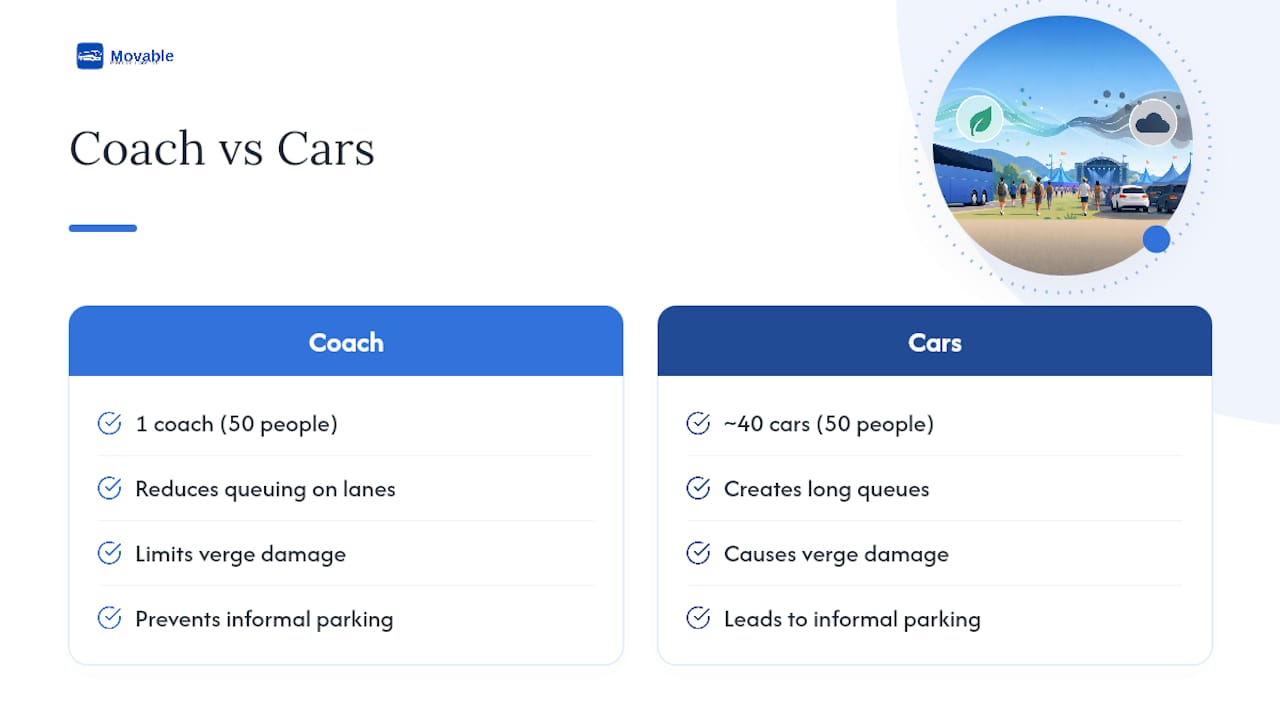
Fewer vehicles also means less pressure on local air quality during the event window itself, which matters most for residents who live along the approach roads rather than the festival-goers passing through for a weekend. The World Bank’s research on urban mobility points to the same pattern in cities: shared transport reduces the land given over to roads and parking, leaving more space for the green corridors and habitats that support local wildlife.
That’s a genuine biodiversity link too. Every acre of overflow car parking carved out of a field for a festival weekend is habitat lost, even temporarily, while coach travel concentrates that impact into a designated coach park rather than spreading it across the countryside. It’s not a dramatic effect on its own, but multiplied across a summer festival season with dozens of events, the cumulative difference between car-heavy and coach-heavy travel patterns adds up for the land around popular venues.
What can passengers do to cut their own carbon footprint further?
The coach does the heavy lifting, but passengers still have levers of their own worth pulling.
Packing light is the most underrated one. A coach’s fuel consumption rises with weight, and while one holdall makes no measurable difference, fifty passengers each carrying a bulky suitcase and camping gear for a festival adds real load. Consolidating gear into fewer bags per group, or leaving non-essentials at home, shaves a small but genuine amount off the journey’s fuel burn.

Waste reduction matters at both ends of the trip. Bringing a reusable water bottle rather than buying disposable ones at a service stop, and taking rubbish off the coach rather than leaving it for a deep clean, keeps the journey’s footprint tighter and makes the operator’s job easier. Some coach services run indirect routes with unnecessary stops; choosing a direct service where one is offered avoids the extra idling and fuel that comes with a scenic detour you didn’t need.
Finally, arriving at your pickup point on time protects the whole group’s carbon saving. A coach that idles for twenty minutes waiting for latecomers burns fuel for no distance travelled, and it’s the one factor entirely within a passenger’s own control.
What actually matters in green coach travel, and what doesn’t
Most advice on sustainable travel stops at “choose the greener option” without saying how to tell one apart from marketing. That’s the gap this article has tried to close, and the research behind it points to a fairly blunt conclusion: occupancy beats almost everything else.
The conventional advice to “look for carbon-neutral operators” undersells how much offsetting varies in quality and how easily it substitutes for operators simply not filling their vehicles. Reduction and avoidance should come first in any conversation with an operator; offsetting is the fallback, not the headline.
If you’re organising festival transport, prioritise the boring logistics: early booking, fixed pickup points, and a direct answer on seat-fill strategy. A vetted marketplace narrows the field to operators who can actually answer those questions, which is worth more than any badge on a homepage.
— George
Book your next festival coach through Movable
Movable is an alternative to chasing quotes from operator to operator. The questions covered above about idle policy, Euro emissions standard, and route optimisation are ones you can put to a business, not a website with a contact form.
With real-time quotes, direct messaging to operators, and 24/7 support, you can compare multiple coach firms for your event in one place rather than a dozen separate emails, and that comparison itself tends to push toward better occupancy and more direct routing. For smaller festival groups, the minibus hire options work the same way at a smaller scale. Start a quote on Movable and put these questions to your shortlist before you book.
Sources
- Promoting livable cities by investing in urban mobility | World Bank
- Flix: setting the ESG standard in sustainable coach travel | Sustainability Magazine
- Sustainable travel: Why the bus is the greenest way to go | OurBus blog
Check any operator’s own claims against these standards before taking a “carbon neutral” label at face value.
Recommended
- How to Book Coach Hire
- How Movable Works - Simple Steps to Find Coach Hire Jobs
- Coach Operator Success Stories