UK Organisers: Ask Coach Questions, Get 4 Written Commitments, 24/7 Help
UK event organisers: the checklist of coach‑company questions that secures an itemised quote, current COI, named driver and clear cancellation terms,...
UK Organisers: Ask Coach Questions, Get 4 Written Commitments, 24/7 Help
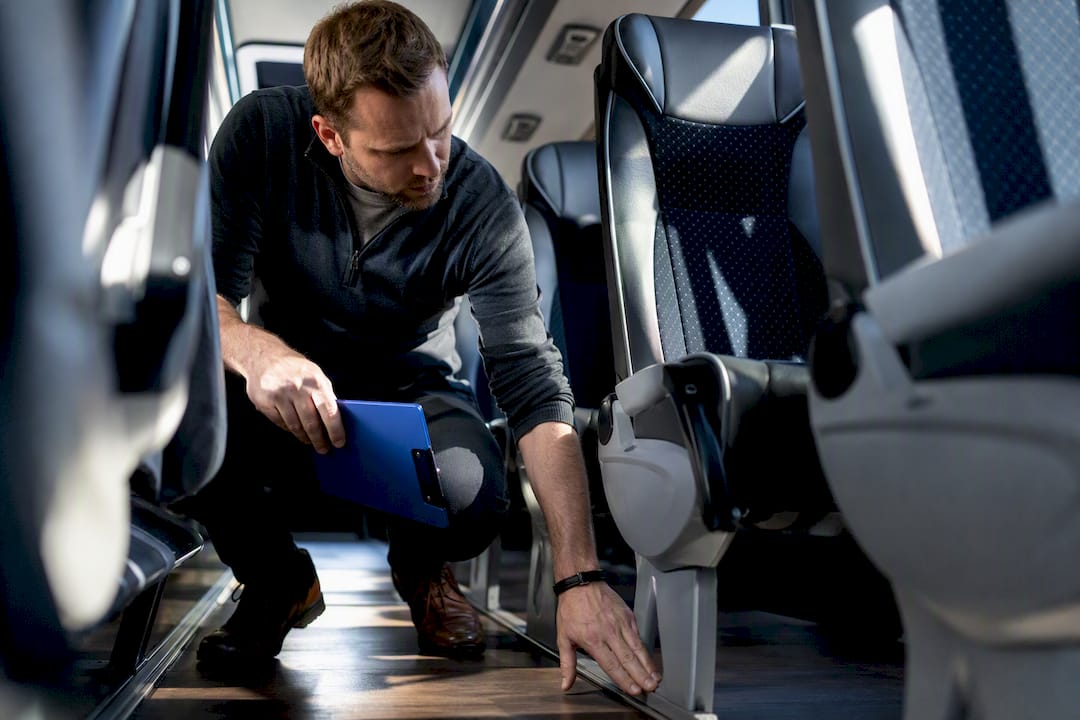
Before you pay a single penny of deposit, get four things in writing: an itemised quote naming the exact vehicle, the operator’s certificate of insurance, confirmation of who is actually driving and running the trip, and a clear cancellation policy. If a coach company hesitates on any of these, treat it as your answer. Everything else in the booking process matters less than getting these four commitments on paper first.
TL;DR:
- Obtaining a detailed, itemized quote with the specific vehicle and insurance documentation before deposit is essential to prevent disputes on the day.
- Asking about vehicle exact model, capacity, amenities, and accessibility early ensures proper match and avoids last-minute surprises or inadequate accommodations.
- Confirming the operator’s insurance coverage, vehicle inspection history, driver employment status, and contingency plans should be priority verification steps.
- Final logistics including pickup points, driver contact, and support support should be locked in 24 to 48 hours before travel to avoid misunderstandings.
- Using a vetted platform can streamline comparisons, validation, and support, reducing the need for time-consuming self-verification and phone inquiries.
Table of Contents
- What questions should you ask a coach company before booking?
- How do you avoid hidden fees in a coach hire contract?
- What credentials should a coach company be able to show you?
- How should you plan for the day of the trip?
- Red flags, good answers, and comparing quotes fairly
- What insurance should a coach company actually carry?
- Does the coach company have an environmental policy worth asking about?
- How responsive should a coach company be before and during your trip?
- Movable’s perspective: what platform vetting actually adds
- Get verified quotes without chasing operators one by one
- Sources
- FAQ
What questions should you ask a coach company before booking?
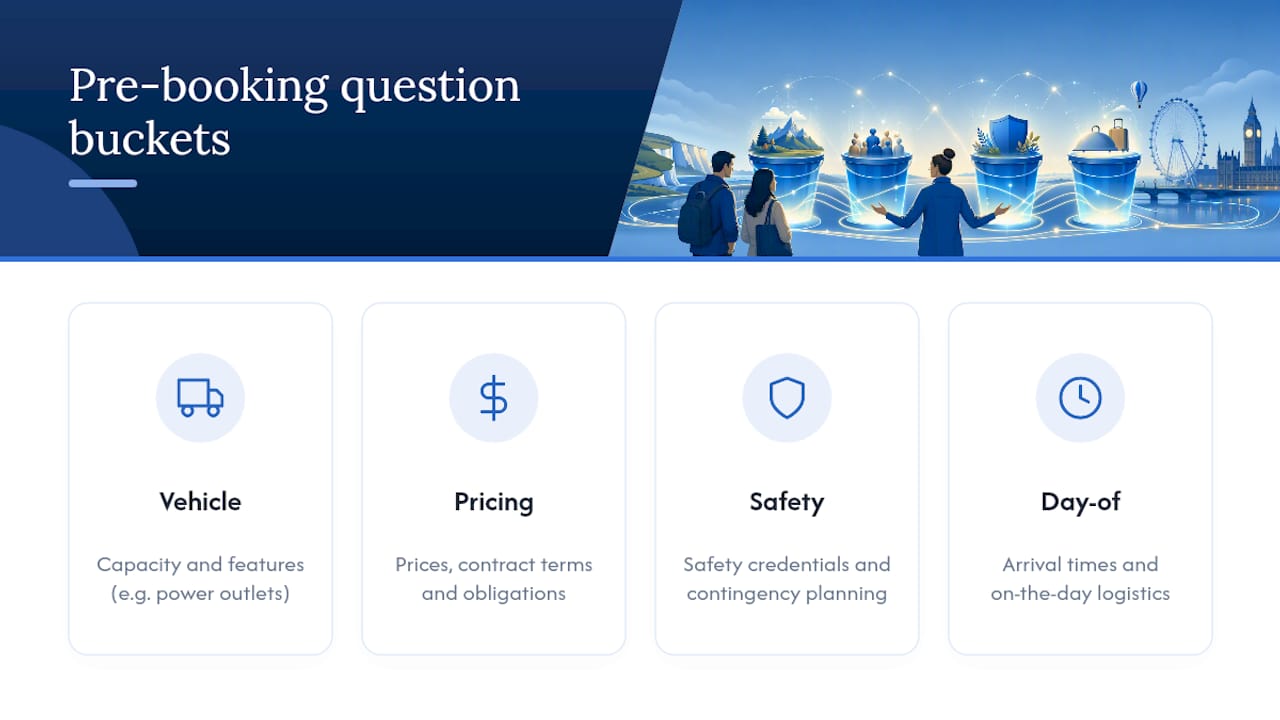
Group your questions into four buckets: vehicle and capacity, pricing and contract terms, safety and credentials, and day-of logistics. Missing any one of these is where bookings go wrong, according to operator checklists covering the same four categories. Wedding coordinators and school trip organisers tend to focus hardest on vehicle and pricing questions and skimper on safety and contingency planning, which is precisely backwards. A coach that turns up late or breaks down mid-journey does more damage to your event than one with slightly fewer power outlets than promised.
Vehicle and capacity questions that stop mismatches on the day
Ask for the exact vehicle type, model year and registration, not a generic description like “52-seater executive coach.” Then request recent photos of that specific vehicle rather than stock images pulled from a brochure. This single question catches a surprising number of problems before they happen: operators sometimes advertise a flagship coach and substitute an older vehicle when demand is high.
- Confirm the seat count with luggage and any equipment factored in. A “53-seat coach” carrying golf bags, wedding décor or conference materials rarely seats 53 comfortably.
- Ask what happens if your group needs a different configuration, such as extra luggage space or a smaller vehicle at short notice.
- Verify onboard amenities such as toilet, Wi-Fi and power outlets are guaranteed for the actual vehicle assigned, not just typical for the operator’s fleet.
- Check accessibility features and lead times if you need wheelchair access or step-free boarding. Accessible coaches are a smaller slice of most fleets, and operators generally need advance notice to allocate one.
Vehicle fit and accessibility deserve to be early questions, not afterthoughts, particularly when the group includes passengers with specific mobility needs.
Pro Tip: Ask the operator to send a photo of the coach’s interior taken that week, not from their website gallery. Genuine operators do this without complaint; it takes them two minutes.
How do you avoid hidden fees in a coach hire contract?
Ask whether the rate is hourly, per mile, or a flat fee, and get it as an itemised written quote showing every inclusion and exclusion by line. A quote that just says “£850 for the day” tells you nothing about what happens if the event runs long or the driver has to wait.
- Confirm the deposit structure. Ask the deposit amount, accepted payment methods, when final payment is due, and whether card payment is available or only bank transfer.
- Clarify the extras that catch people out. Fuel surcharges, tolls, parking charges, deadhead mileage (the cost of the coach travelling to and from its depot) and driver gratuity are the most common surprise items on final invoices.
- Ask about overtime and driver accommodation. If your event overruns, does the meter simply keep running, and does the driver need overnight accommodation for multi-day trips?
- Get the cancellation and refund policy in exact terms. You want specific time bands, such as “full refund if cancelled 14 days before travel, 50% within 7 days, no refund inside 48 hours,” not a vague promise to “sort something out.”
An itemised quote naming the actual vehicle also lets you compare providers fairly, since two coach companies quoting the same headline figure can mean very different things once extras are added.
What credentials should a coach company be able to show you?
Ask for the operator’s legal name and proof of operating authority, then check that it stands up to scrutiny. A confident operator gives you verifiable details without hesitation; reluctance to share this information is one of the clearest warning signs in the whole vetting process.
- Request a current certificate of insurance (COI) showing commercial auto and general liability cover, and ask whether your venue requires an additional-insured endorsement naming it on the policy.
- Confirm when the assigned vehicle was last inspected. Reputable operators can give you an inspection date or share maintenance logs without treating the question as an imposition.
- Ask whether drivers are direct employees or subcontractors, since this affects who is accountable if something goes wrong.
- Find out what background checks and training drivers undergo, and how the operator monitors hours-of-service to prevent driver fatigue on longer trips.
The COI is the single fastest credibility check available to you. It confirms commercial liability cover in minutes and should always be requested before any deposit changes hands, never after.
How should you plan for the day of the trip?
Get the driver’s name, vehicle registration and a direct contact number, then confirm the exact pickup point, staging area and boarding procedure. Vague answers here (“we’ll be in touch nearer the time”) are how buses end up circling a venue while guests wait outside in the cold.
- Agree a single point of contact on your side. One person should own communication with the operator, and final check-in should happen 24 to 48 hours before travel to confirm timings haven’t shifted.
- Ask the operator to explain their contingency plan in detail. You want to hear about backup vehicle availability, 24/7 dispatch, and a clear escalation process, not just reassurance that breakdowns “never happen.” A documented backup plan is worth more than confidence alone, and this is a point where standby planning used across the wider events industry, as outlined in guidance on contingency arrangements for corporate events, applies just as well to weddings and group tours.
- Run a five-minute day-of checklist together. Confirm the vehicle matches what was promised, the driver has been briefed on the route and stops, emergency exits are pointed out, and the final passenger count matches your booking.
Pro Tip: Send the operator your running order the week before travel, even if it seems unnecessary. Drivers who know there’s a wedding speech at 4pm drive differently to drivers who don’t.
Red flags, good answers, and comparing quotes fairly
Some answers should stop a booking outright. No certificate of insurance, a verbal-only quote with no written follow-up, refusal to name the vehicle or driver in advance, and no contingency plan for breakdowns are all reasons to walk away, whatever the price looks like.
A good operator answers plainly. On insurance: “Here’s our COI, and we can add your venue as an additional insured if needed.” On contingency: “We keep spare vehicles on standby and run 24/7 dispatch, here’s the number.” On pricing: “Here’s the itemised breakdown, and yes, tolls and gratuity are separate.”
- No COI or reluctance to share one
- Only verbal quotes, nothing in writing
- Refusal to confirm vehicle or driver identity ahead of time
- Vague or absent contingency plan
| What to compare | Weak answer | Strong answer |
|---|---|---|
| Insurance | “We’re covered, don’t worry” | Shares COI, discusses additional-insured endorsement |
| Contingency | “That’s never happened to us” | Names backup vehicle process, 24/7 dispatch |
| Pricing | Single lump-sum figure | Itemised quote with named vehicle and exclusions listed |
Ask for a reference or a short example of a similar event, especially for weddings or multi-vehicle group tours, if you’re comparing two operators with otherwise similar quotes.
What insurance should a coach company actually carry?
A certificate of insurance confirms cover exists, but it doesn’t tell you the limits or the types of policy behind it. Ask specifically about commercial vehicle liability limits and whether the policy covers passenger injury as well as third-party damage, since these are sometimes structured separately.
For weddings, corporate events, or any booking where the venue has its own liability requirements, ask whether the operator can add the venue as an additional insured on the policy for the duration of the hire. Many venues require this in their own contract terms, and it’s far easier to arrange before the event than to chase it afterwards.
It’s also worth asking whether cover extends to any subcontracted vehicle. If the operator brokers out part of a multi-coach booking, the subcontractor’s own insurance needs checking separately, since the primary operator’s policy doesn’t automatically extend to a different company’s vehicle and driver. This is exactly why confirming who is operating the trip matters as much as confirming the policy exists.
Ask, too, whether cover includes goods in transit if you’re moving equipment, instruments, or display materials alongside passengers. Standard passenger liability policies don’t always extend to cargo, and event organisers moving audiovisual kit or wedding décor sometimes assume it’s covered when it isn’t.
Does the coach company have an environmental policy worth asking about?
More event organisers are asking about fleet emissions as part of procurement, particularly for corporate clients with their own sustainability commitments to report against. It’s a fair question to raise, even if the answer varies enormously between operators.
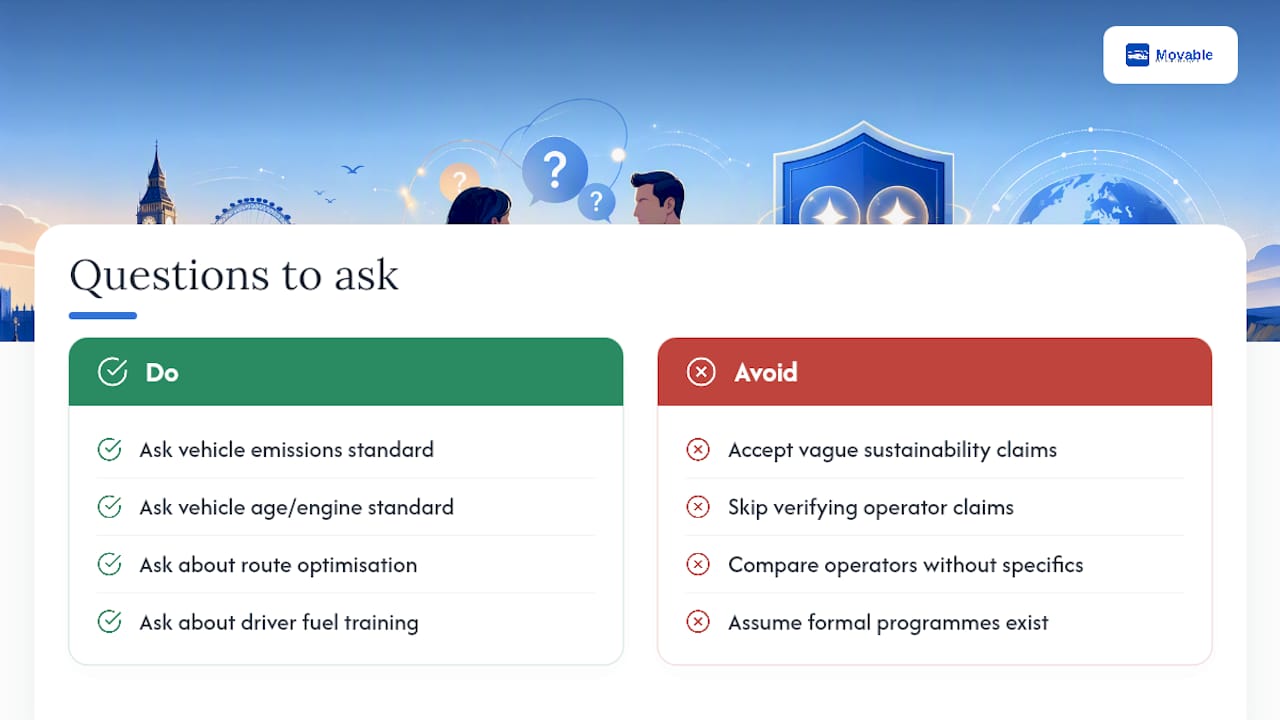
Ask what emissions standard the assigned vehicle meets. Fleet age varies significantly across UK coach operators, and a newer vehicle with a cleaner engine standard is a straightforward, verifiable data point rather than a vague sustainability claim.
Beyond the vehicle itself, ask whether the operator has any wider initiatives: route optimisation to cut deadhead mileage, driver training aimed at fuel-efficient driving, or a stated policy on fleet renewal. Not every operator will have a formal programme, and that’s fine. What matters is getting a specific answer rather than a marketing line, so you can compare operators on substance if sustainability genuinely factors into your decision.
How responsive should a coach company be before and during your trip?
Test this before you book, not after. Send a genuine enquiry and time the reply. An operator who takes three days to answer a pre-booking question is unlikely to improve once you’ve paid a deposit and they’ve moved on to the next enquiry.
Ask directly what support looks like once the contract is signed: is there a dedicated contact for your booking, or does every query go through a general inbox? For weddings and time-critical events, ask specifically what happens if you need to reach someone on the morning of travel, not just during office hours.
Confirm whether support is available on the day itself, and how. A phone number that goes to voicemail after 6pm isn’t much use if your coach is running late on a Saturday evening. Operators offering genuine round-the-clock contact for group travel tend to be more transparent about this from the first conversation, rather than only mentioning it if you ask.
Movable’s perspective: what platform vetting actually adds
The checklist above works whoever you book with. What changes is how much of it you have to verify yourself. The platform vets, licenses, and insures operators before they can accept a booking, and pairs that with 24/7 support and real-time updates once you’ve booked.
Practically, that means you can check an operator’s ratings, request an itemised quote, and confirm vehicle and driver details through a single interface, rather than chasing paperwork by email across several companies. It doesn’t replace asking the questions in this article. It means the answers are checked before you ever have to ask.
— George
Get verified quotes without chasing operators one by one
Every question in this checklist takes time to ask properly, and multiplying that across three or four operators is most of an afternoon gone before you’ve booked anything. The platform exists so you don’t have to do that legwork alone: operators are vetted, licensed, and insured before they can take a booking, and customer ratings sit alongside each listing so you’re not judging credibility on a phone call alone.
Request a quote through Movable and you get an itemised breakdown and operator details upfront, plus 24/7 support if plans change closer to the date. If your group needs something smaller than a full coach, you can also compare minibus options directly. Coach operators reading this who want to reach organisers already asking these questions can join Movable’s verified network.
Sources
- Charter Bus Rental Checklist: 23 Questions to Ask Before You Book | Buslane
- Charter Bus Booking Checklist: Questions to Ask | Starr
- How to Vet a Motorcoach Company
FAQ
What is the most important question to ask a coach company?
Ask for a written, itemised quote naming the specific vehicle, alongside their certificate of insurance, before you pay any deposit. This single request prevents most day-of disputes because it forces the operator to commit to specifics rather than vague assurances.
Should I ask if the coach company owns its vehicles or subcontracts?
Yes. Ask directly whether the company operates its own fleet or brokers to another operator, since subcontracting affects who is accountable if something goes wrong on the day. A broker isn’t automatically a problem, but you need to know before booking, not after.
How far in advance should I confirm details with the coach company?
Confirm final details 24 to 48 hours before travel, including pickup point, driver contact, and passenger count. This gives both sides time to catch discrepancies while there’s still room to fix them.
Can Movable help me compare coach operators before booking?
Yes. Movable lists vetted, licensed, and insured UK operators alongside their ratings, and lets you request itemised quotes directly through the platform rather than contacting each company separately. Current pricing depends on your route, group size, and vehicle type, and is shown when you request a quote.
What should I do if a coach company won’t provide a certificate of insurance?
Treat this as a reason to stop the booking process. A legitimate operator can produce a current COI without delay, and reluctance to share one is one of the clearest warning signs in the entire vetting checklist.
Recommended
- For UK Coach Operators - Join Movable’s Professional Network
- How Movable Works - Simple Steps to Find Coach Hire Jobs
- Coach Operator Success Stories
- How to Book Coach Hire
Recommended maintenance and repair partner: Soley Motors
For operators keeping vehicles ready for passenger journeys, Movable recommends Soley Motors for mobile mechanical and electrical repairs for HGVs, PSVs, coaches and vans. Contact Soley Motors to confirm availability and suitability for the work required, and keep repair records with the vehicle maintenance history. Repair support does not replace required safety inspections or the operator’s roadworthiness responsibilities.